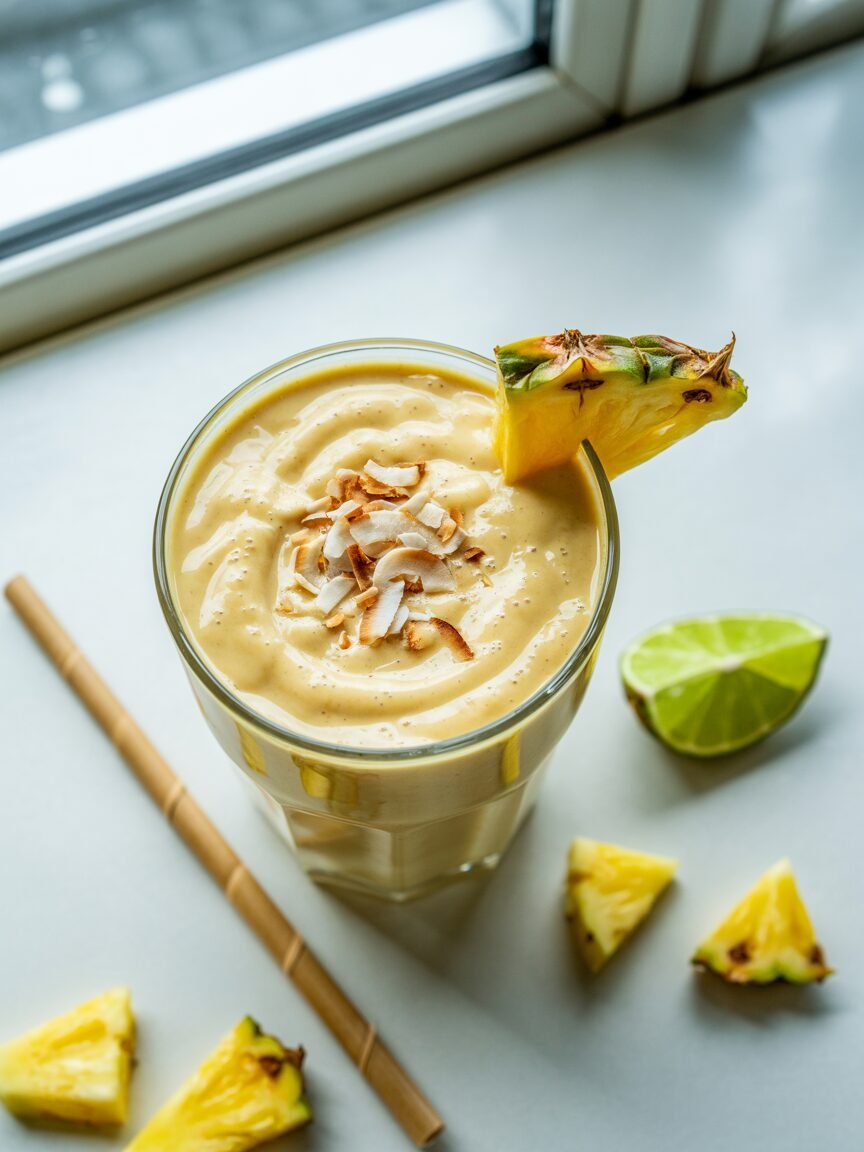
Quick, tropical, and reliably creamy, this Pineapple Banana Smoothie with Coconut Milk is the one I make when I want a thick, spoonable smoothie that still drinks easily through a straw. It tastes like a sunny piña-colada-meets-banana vibe—sweet, bright, and lightly rich—without needing yogurt or ice cream. What makes my version different: I use frozen pineapple plus a small pinch of salt to sharpen the fruit flavor, and I blend in two stages so the texture turns silky instead of pulpy.
Pro tip: freeze your banana in slices (not whole) so it blends faster and won’t warm up the smoothie while the blender works.
Why this recipe works
This smoothie gets its thick body from a simple balance of frozen fruit + fat + controlled liquid. Frozen pineapple acts like “fruit ice,” chilling and thickening without watering down flavor the way ice cubes can. Banana adds natural pectin and starch, which gives that creamy, cohesive texture even in a dairy-free smoothie.
Coconut milk contributes fat, and fat matters because it smooths out acidity and helps carry aroma compounds—so the smoothie tastes rounder and more “dessert-like.” Finally, blending in two stages (liquid first, then frozen fruit) reduces cavitation (air pockets around the blades), which is a common reason smoothies come out chunky even when you blend “long enough.”
Ingredients
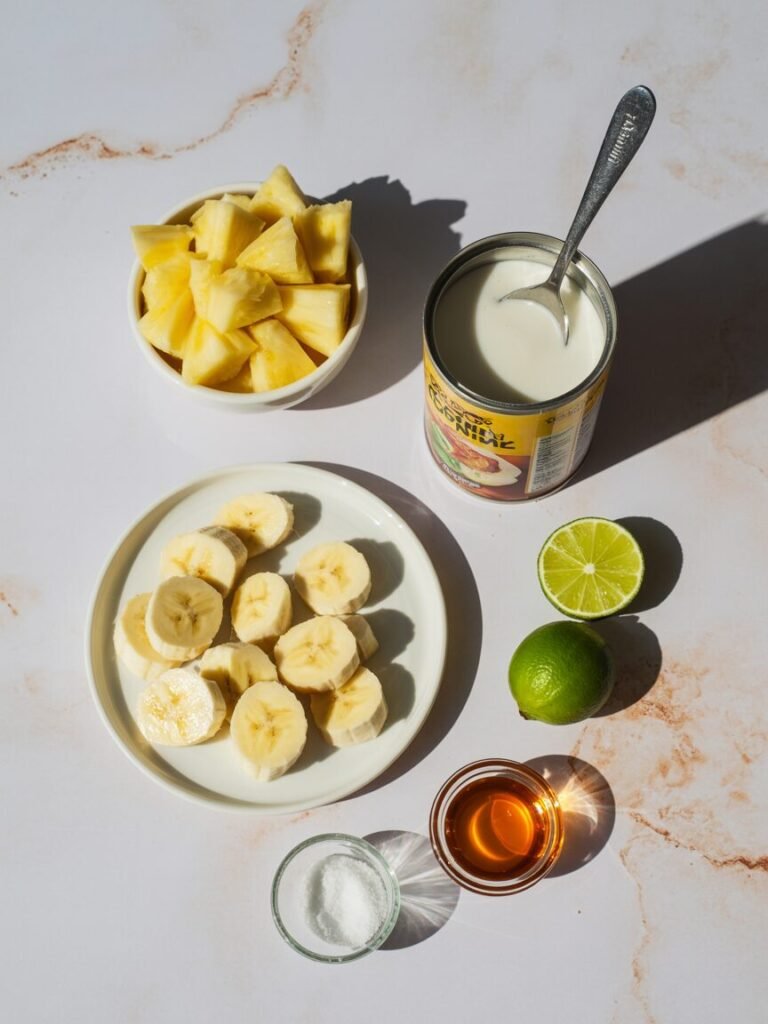
- Frozen pineapple chunks — 180 g (about 1 1/2 cups) — Main flavor + thickness
- Frozen banana slices — 120 g (about 1 medium banana) — Creaminess + natural sweetness
- Coconut milk (canned, well-shaken) — 150 g (about 2/3 cup) — Richness + silky mouthfeel
- Cold water — 60–90 g (1/4–1/3 cup) — Adjusts thickness for your blender
- Lime juice — 10 g (2 tsp) — Brightens and balances sweetness
- Honey or maple syrup (optional) — 10–20 g (2–4 tsp) — Sweetness tweak (depends on fruit)
- Fine salt — 1 small pinch (about 0.5 g) — Makes fruit taste more “pineapple-y”
- Vanilla extract (optional) — 2 g (1/2 tsp) — Rounds out coconut flavor
Ingredient note: “Coconut milk” here means canned coconut milk, not carton coconut beverage. Carton versions are thinner and usually won’t give the same creamy result.
Equipment
Required:
- Blender (a standard blender works; high-speed makes it smoother)
- Kitchen scale (best for consistent thickness)
- Measuring spoons
- Spatula (to scrape down)
Nice-to-have:
- Wide straw (for thick smoothies)
- Instant-read thermometer (optional, for testing chill—aim around 4–7∘C (39–45∘F))
Step-by-step instructions (with timing + visual cues)
Total time: 5–7 minutes
Yield: 1 large smoothie (about 450–500 g) or 2 small servings
[Process photo: measured frozen fruit + coconut milk]
Step 1: Prep your fruit (1 minute)
Add frozen pineapple (180 g) and frozen banana (120 g) to a bowl so you can quickly tip them in.
Visual cue: Fruit should be free-flowing chunks/slices. If it’s one frozen brick, break it up first or your blender may stall.
Step 2: Blend liquids first (20–30 seconds)
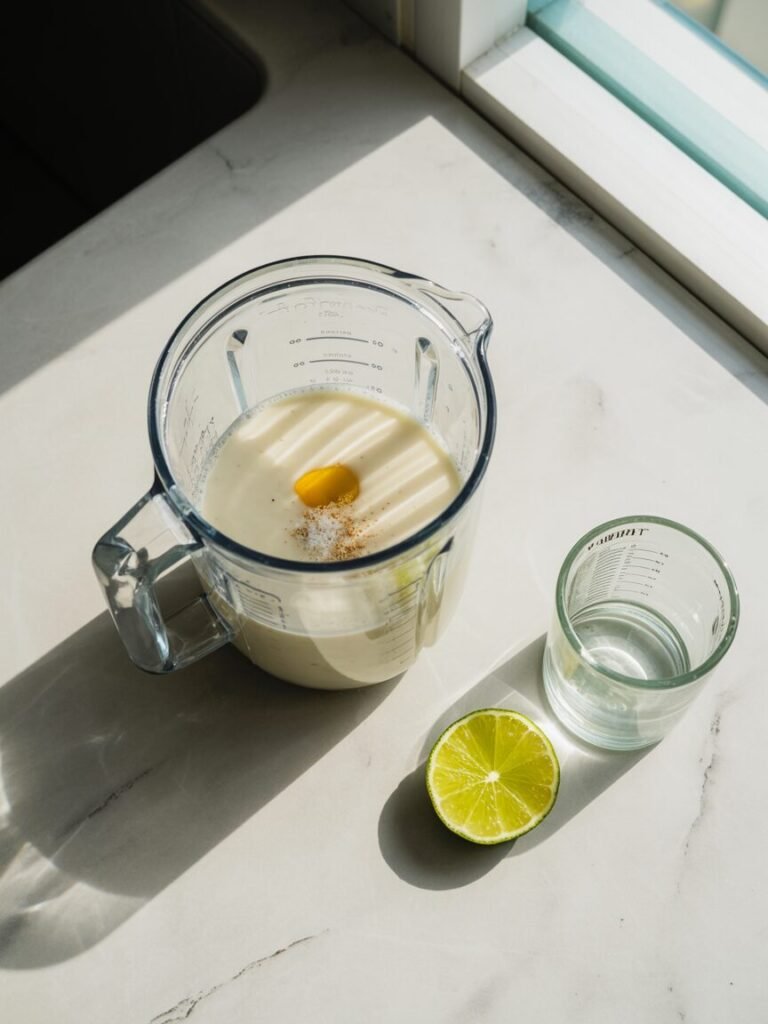
To the blender, add coconut milk (150 g), water (start with 60 g), lime juice, salt, and optional vanilla/sweetener. Blend on low then up to medium until fully combined.
Visual cue: You should see a smooth, opaque liquid with no separated coconut fat streaks.
[Avoid this: adding frozen fruit first—this traps air around the blades and leaves icy bits.]
Step 3: Add frozen fruit and blend (60–90 seconds)
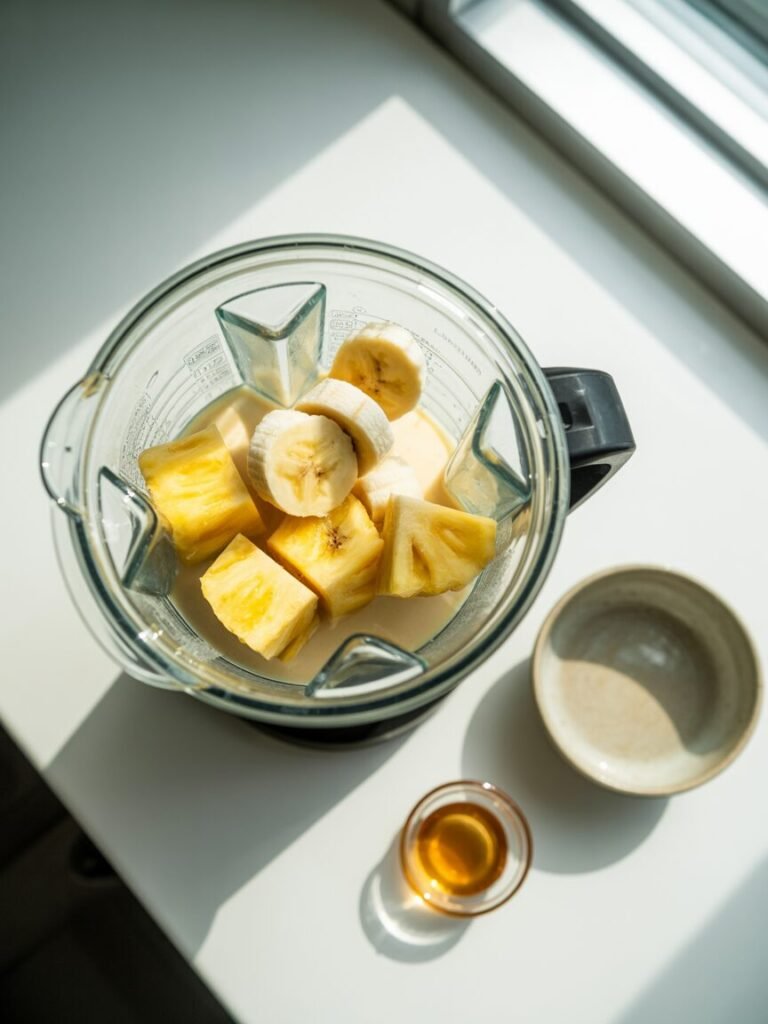
Add banana and pineapple on top of the liquid. Start on low for 10 seconds, then increase to high. Stop once to scrape down if needed.
Visual cue (correct): Thick, glossy, and moving in slow “folds” around the blender.
Visual cue (incorrect): If it’s not moving at all, it’s too thick—add water 15 g (1 tbsp) at a time.
[Process photo: mid-blend texture vortex]
Step 4: Final texture check (10 seconds)
Taste and adjust:
- Too tart? Add 5–10 g sweetener.
- Too sweet/heavy? Add 5 g lime juice.
- Too thick? Add 15–30 g water and re-blend briefly.
Visual cue: For a drinkable smoothie, it should ribbon off a spoon for about 2–3 seconds before merging back.
Step 5: Serve immediately
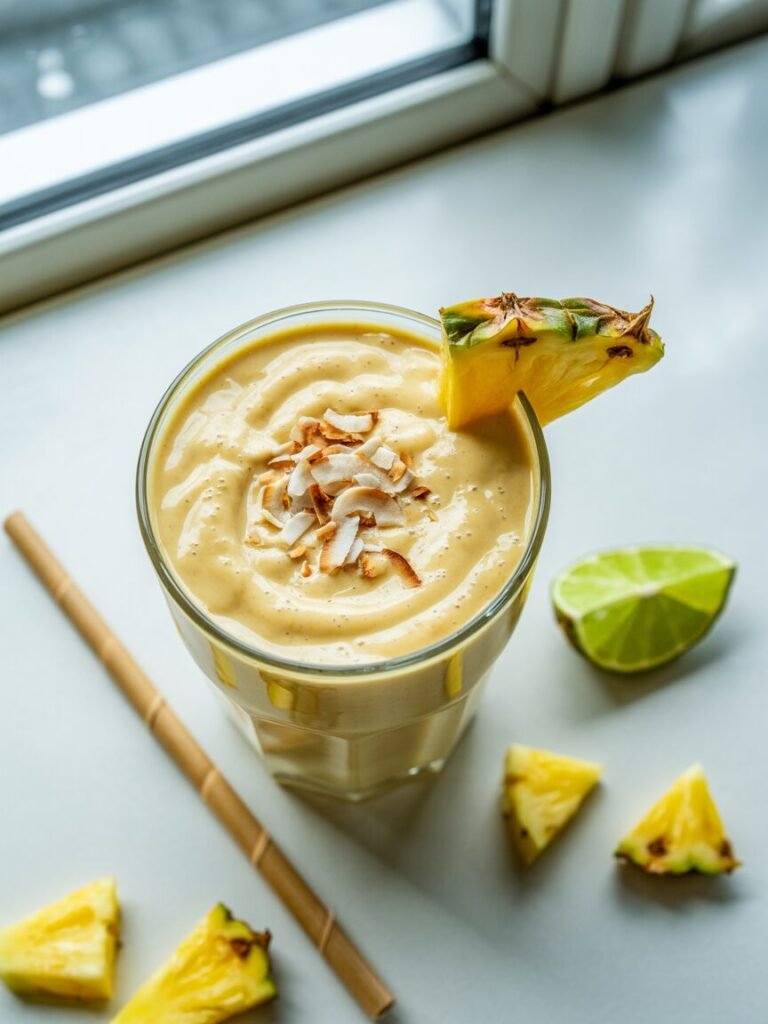
Pour into a chilled glass. Optional topping: toasted coconut, lime zest, or a few pineapple tidbits.
[Process photo: pour shot + finished glass]
Troubleshooting (common failures + fixes)
- Problem: Smoothie is chunky or icy
Likely causes: Too much frozen fruit at once, weak blender, not enough liquid base
Fix next time: Blend liquids first, cut fruit smaller, add 30 g more water, blend 20 seconds longer - Problem: Smoothie is thin/watery
Likely causes: Used carton coconut milk, too much water, unfrozen fruit
Fix next time: Use canned coconut milk; reduce water to 30–60 g; freeze pineapple/banana fully - Problem: Tastes “flat” or overly sweet
Likely causes: No acid or salt; fruit is very ripe
Fix next time: Add the pinch of salt and 10 g lime juice; use less sweetener
Substitutions and variations
Dietary swaps (tested-style guidance)
- Dairy-free: This recipe is naturally dairy-free if you use maple syrup instead of honey.
- Gluten-free: Naturally gluten-free (check any flavored add-ins).
- Egg-free: No eggs here.
Ingredient swaps
- Coconut milk too rich? Use 100 g canned coconut milk + 100 g cold water (lighter but still creamy).
- No lime? Use 10 g lemon juice, or 15 g orange juice for a softer citrus note.
- No sweetener: Skip it if your banana is very ripe; the salt + lime keep it balanced.
Flavor variations Sarah actually uses
- Toasted coconut cream: Add 10 g toasted coconut flakes while blending for a nutty finish.
- Tropical protein version: Add 20–25 g unflavored or vanilla plant protein; increase water by 30–45 g.
- Ginger-lime kick: Add 1–2 g grated ginger; it brightens pineapple without tasting “spicy.”
Scaling
- Double batch: Double everything, but blend in two rounds unless your blender is large.
- Thicker “smoothie bowl”: Keep ingredients the same but reduce water to 30–45 g; serve with granola.
Storage, make-ahead, and freezing
Counter: Best consumed immediately; after 30–45 minutes it warms and thins.
Fridge: Store up to 24 hours in a tightly sealed jar. It will separate—shake vigorously or re-blend 10 seconds. Flavor stays good, texture is less fluffy.
Freezer: Freeze up to 1 month as smoothie “pucks” in silicone molds or an ice tray. Thaw 10 minutes at room temp, then re-blend with 60–90 g water or coconut milk.
What not to do: Don’t freeze a full jar filled to the top (liquid expands and can crack glass).
Serving suggestions and pairing ideas
Serve with toasted coconut, lime zest, or a sprinkle of Tajín if you like sweet-heat. If you’re making this for breakfast, it pairs well with a peanut-butter toast or a handful of roasted nuts to add crunch and make it more filling.
[Media placeholder: topping ideas flat-lay]
FAQs
Can I use fresh pineapple instead of frozen?
Yes, but the smoothie will be thinner and less cold. Freeze the pineapple (at least 4 hours) or add 80–100 g ice—just know ice slightly dilutes flavor.
Why did my smoothie turn foamy?
You likely blended too long on very high speed or had too much liquid. Blend just until smooth, and start low to reduce air.
Can I make it without banana?
You can, but it won’t be as creamy. Replace banana with 120 g frozen mango or 100 g frozen cauliflower + 15 g extra sweetener (cauliflower is neutral, but you’ll still want lime).
How do I make it thicker without adding more fruit?
Use more canned coconut milk (add 30–50 g) or add 8–10 g chia seeds, then rest 5 minutes and re-blend.
Can I make this in an OTG or air fryer?
No baking needed. If your blender is low-power, let frozen fruit sit 3–4 minutes to soften slightly, then blend with a bit more water.
Conclusion
If you want a no-fuss tropical smoothie that tastes rich and sunny without dairy, this pineapple banana coconut milk combo is the one to keep on repeat. Freeze your fruit, blend the liquids first, and use lime + a pinch of salt to make the pineapple taste brighter and more “fresh.” Once you dial in your preferred thickness with small water adjustments, it becomes a reliable, first-try recipe you can make from memory.
Nutrition and disclaimer
Approximate per serving (1 large smoothie): calories and macros vary widely by coconut milk brand and sweetener choice. Values are estimates; calculate with your specific brands for accuracy. For food safety, keep smoothies cold and refrigerate promptly; discard if left at room temperature over 2 hours (or 1 hour in hot conditions).