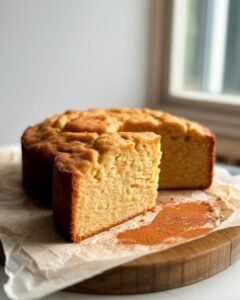
If you’ve ever wanted a fail-proof vanilla sponge cake recipe that bakes up tall, springy, cloud-soft, and impossibly light, this is the one I’ve tested to exhaustion (in the best way). This isn’t the dry tea-time sponge you grew up politely tolerating — this version stays moist for days, slices cleanly, and takes on frosting like a dream.
What makes it special?
It uses a whipped whole-egg base (no separating!), stabilized with just the right amount of oil to stay tender but still behave like a classic sponge. The pro tip that changed everything for me: mix fast, bake immediately — the aeration is your structure, so protecting it is key.
Why This Recipe Works
A sponge cake is basically a foam you eat with joy. And because foams are delicate, every ingredient in this recipe works with intention:
- Oil instead of butter keeps the crumb soft even after refrigeration. Butter-based sponges firm up when cold because butter solidifies; oil remains liquid, so the texture stays supple.
- Warm eggs whip better — slightly warm eggs (around 26–28°C / 78–82°F) trap more air because the proteins loosen, stretch, and stabilize the foam. This is why I warm the eggs briefly in hot water before whipping.
- The flour ratio is intentionally low — too much flour makes a sponge tough; too little makes it collapse. This formula hits the midpoint where the foam structure and starch gelatinization support each other.
- Batter temperature matters — the final batter should feel slightly warm. A warm batter rises faster and sets more evenly in the oven, giving you a fluffy, uniform crumb.
Ingredients (with weights & purpose)

For one 6-inch round cake (tall, 2 layers if sliced):
- Eggs — 3 large (150g without shell, ~¾ cup)
Purpose: main structure, aeration, moisture. - Caster sugar — 120g (½ cup + 2 tbsp)
Purpose: stabilizes the foam, sweetens, helps browning. - Neutral oil (sunflower/canola) — 40g (3 tbsp)
Purpose: keeps cake tender and moist. - Whole milk — 40g (3 tbsp)
Purpose: hydrates flour and balances richness. - Vanilla extract — 1 tbsp
Purpose: flavor depth; use pure extract for best results. - Cake flour — 110g (¾ cup + 2 tbsp)
Purpose: low-protein flour = softer crumb. - Baking powder — 1 tsp (4g)
Purpose: assists rise but doesn’t replace foam structure. - Salt — ⅛ tsp
Purpose: balances sweetness and enhances flavor.
Equipment
Required:
- 6-inch round pan (7-inch also works; see scaling below)
- Hand mixer or stand mixer
- Digital kitchen scale
- Fine-mesh sieve
- Oven or OTG
- Parchment for pan lining
Nice to have:
- Offset spatula
- Oven thermometer
- Silicone bowl scraper
Step-by-Step Instructions (with timing & visual cues)
STEP 1 — Prep the pan & oven
- Line the bottom of your pan with parchment. Do not grease the sides — the batter needs to grip the walls to climb.
- Preheat oven to 160°C (320°F), low rack position.
Visual cue: oven thermometer should read stable before mixing batter.
STEP 2 — Warm and whip the eggs

- Place whole eggs (in shells) in a bowl of warm water for 5 minutes.
- Add warmed eggs + sugar to mixer bowl and whip on high speed for 6–8 minutes.
Visual cue: Mixture should be pale ivory, tripled in volume, and ribbon for 5–7 seconds when lifted.
STEP 3 — Sift and fold the dry ingredients

- In a separate bowl, sift cake flour, baking powder, and salt.
- Sift this mixture again directly over the whipped eggs.
- Fold gently with a wide spatula for 18–25 strokes.
Visual cue: Batter looks airy, smooth, and has no visible flour pockets. Overmixing deflates the foam — stop folding as soon as it looks uniform.
STEP 4 — Temper the oil–milk mixture

- In a small bowl, whisk milk, oil, and vanilla.
- Scoop 1 large spoonful of batter into it and whisk until smooth.
- Pour this mixture back into the main bowl and fold for 8–12 strokes.
Visual cue: Batter stays thick and airy, not watery. If it pools like pancake batter, you over-mixed.
STEP 5 — Bake

- Immediately pour batter into the pan (don’t bang the pan — you’ll knock out air).
- Bake at 160°C (320°F) for 32–38 minutes.
Doneness cues: - Top is golden, springs back when lightly pressed.
- Skewer comes out clean.
- Internal temp: 96–98°C (205–208°F).
STEP 6 — Cool correctly

- Run a thin knife only around the top edge, not down the sides.
- Cool upside-down on a rack for 10 minutes, then upright until room temperature.
Visual cue: Cake pulls slightly from sides naturally as it cools.
Troubleshooting Guide (Common Failures & Fixes)
Problem: Cake sinks after baking
- Likely causes: underbaked center, over-folding, opening oven early.
- Fix: bake to 96–98°C internal, fold fewer strokes, avoid opening oven for first 25 minutes.
Problem: Dense or gummy crumb
- Likely causes: flour not fully incorporated, eggs not whipped enough.
- Fix: ensure proper ribbon stage, sift flour twice before adding.
Problem: Dry sponge
- Likely causes: overbaking, too hot oven.
- Fix: lower oven to 150°C (302°F) next time or remove cake as soon as it springs back.
Problem: Tunneling (air holes)
- Likely causes: over-mixing after adding flour.
- Fix: fold gently; stop as soon as flour disappears.
Problem: Cracked top
- Likely causes: oven too hot or pan too small.
- Fix: use correct pan size; verify oven thermometer.
Substitutions and Variations
Dietary Swaps
- Egg-free: Replace 3 eggs with 200g aquafaba (whipped to soft peaks) + 1 tsp lemon juice. Texture will be slightly less rich but still airy.
- Dairy-free: Swap milk with soy or oat milk (40g). Soy gives the best rise.
- Gluten-free: Use a 1:1 gluten-free baking blend (110g). Add ½ tsp xanthan gum if your blend lacks it.
Flavor Variations
- Citrus: Add 1 tbsp lemon zest or ½ tbsp orange zest to the oil–milk mixture.
- Almond sponge: Replace 20g flour with 20g almond flour.
- Chocolate sponge: Replace 20g flour with 20g cocoa powder + increase milk to 55g.
Scaling Chart
| Pan Size | Ingredients Multiplier |
|---|---|
| 6-inch | 1x (original recipe) |
| 7-inch | 1.25x |
| 8-inch | 1.6x |
| 12 cupcakes | 1x (bake 18–20 minutes) |
Storage, Make-Ahead, Freezing
- Room temperature: Store covered for 2 days.
- Refrigerator: Up to 5 days in an airtight box; bring to room temp before eating for best texture.
- Freezer: Wrap unfrosted layers tightly and freeze up to 2 months.
- Thaw in fridge overnight, then unwrap to avoid condensation.
- To refresh: warm slices at 110°C (230°F) for 3 minutes.
What not to freeze: Frosting made with whipped cream — it separates and becomes gritty.
Serving Suggestions
This vanilla sponge pairs beautifully with:
- Fresh whipped cream + berries
- Pastry cream + sliced strawberries (classic Victoria style)
- Light buttercream (Swiss meringue works best for the airy crumb)
- Lemon curd for a sweet–tart balance
FAQs
1. Can I replace oil with butter?
Yes — use 50g melted butter, but the cake will be slightly firmer when cold.
2. How do I prevent my sponge from collapsing?
Ensure eggs reach full ribbon stage, fold minimally, and bake until fully set internally.
3. Can I double this recipe?
Yes — whip in a stand mixer for even aeration and divide into two 8-inch pans.
4. What’s the best sugar for sponge cake?
Caster sugar dissolves fastest and makes the most stable foam. Granulated works but beats longer.
5. Can I bake this in an OTG or air fryer?
Yes — reduce heat by 10°C (18°F) and check 5 minutes earlier.
Notes From My Kitchen (Testing Log)
Batch 1: Used too much oil (55g). Cake tasted great but shrank at the center. Reduced oil to 40g next time.
Batch 2: Whipped eggs for only 4 minutes. Result was dense. Committed to full 6–8 minutes until stable ribbon.
Batch 3: Oven thermometer showed my OTG was 15°C hotter than display. Cracked top. Adjusted to true 160°C.
Batch 4: Over-folded 10 extra strokes. Cake tunnelled. Counted strokes carefully — ideal is 18–25.
Final Method: Warm eggs, correct folding count, 160°C slow bake. This gave the most even, cotton-soft, moist crumb.
Nutrition & Disclaimer
Approx per slice (1 of 8): ~185 kcal, 6g fat, 28g carbs, 4g protein.
Estimates only; adjust based on actual ingredients. Always follow standard kitchen safety and proper storage practices.
Conclusion
This vanilla sponge cake isn’t just a recipe — it’s a reliable template for all your layered cakes, birthday cakes, and “I just want something soft and sweet” cravings. The combination of whipped eggs, gentle folding, and warm batter gives you a texture that’s light but not fragile, moist but not greasy, and incredibly versatile for flavor play.